Madusae Scyphozoan Jellyfish Ichnofossils
Phylum Cnidaria, Class Scyphozoa; with similarity to extant Order Scyphomedusae
Geologic Time : Upper Cambrian
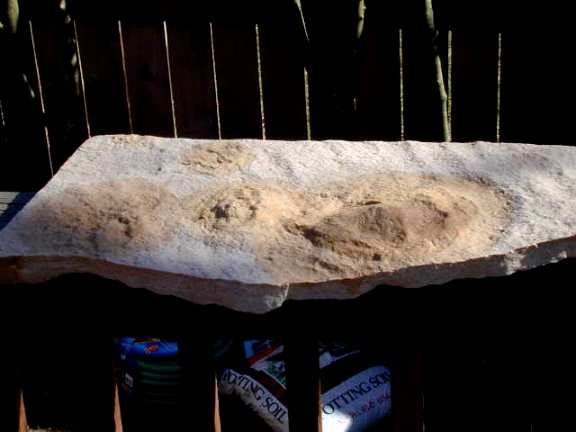
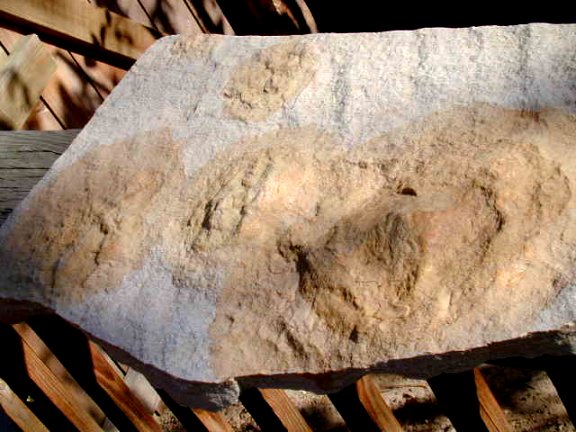
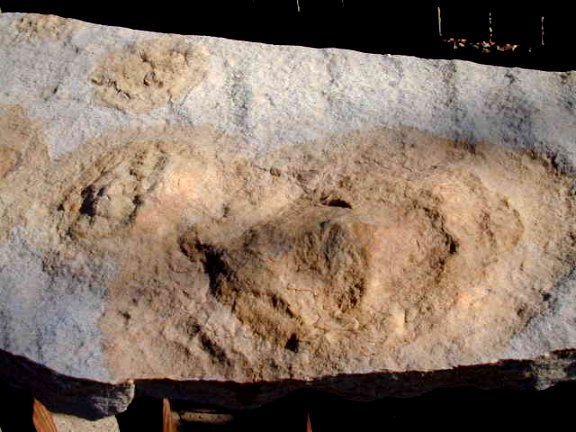
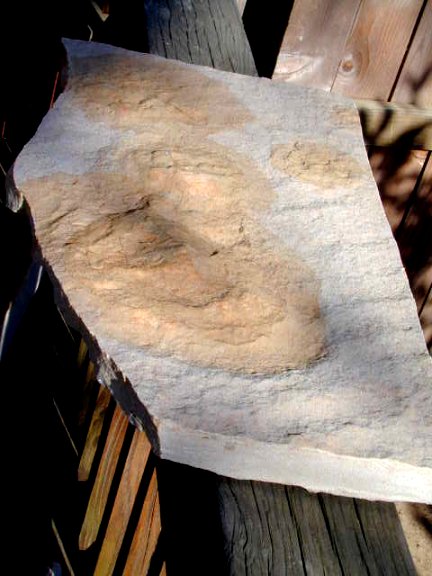
Size (25.4mm=1 inch): Matrix measures 24 by 13 1/2 by 1 1/4 inches; jellyfish are about 11 3/4, 7 1/2, 6, and 4 inches in diameter
Fossil Site: Krukowski Quarry, Mount Simon Wonewoc Sandstone, Elk Mount Group, Mosinee,Wisconsin
Code: DD38
Price: Sold
 Phylum
Cnidaria (anemones, corals, jellyfish and sea pens) are among the most ancient
animals, simplest in body form, and yet are ubiquitous and widespread even
today in marine environments. The earliest forms in the fossil record appear
in Ediacarian fauna of Southern Australia, which dates to the Precambrian
some 600 million years ago. This is clear testiment that old and simple
animals can be enormously successful.
Phylum
Cnidaria (anemones, corals, jellyfish and sea pens) are among the most ancient
animals, simplest in body form, and yet are ubiquitous and widespread even
today in marine environments. The earliest forms in the fossil record appear
in Ediacarian fauna of Southern Australia, which dates to the Precambrian
some 600 million years ago. This is clear testiment that old and simple
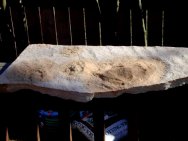
animals can be enormously successful. Here we have a sandstone plate with a large Madusae Cambrian Madusae Ichnofossil from an intriguing Cambrian site in Central Wisconsin. Being comprised entirely of soft tissue unlike animals with exoskeletons (e.g., trilobites) or skeletons (vertebrates), jellyfish fossils are body fossils that are impressions of the jellyfish. Such fossil impressions are rare, especially from the Cambrian. Jellyfish were some of the most ferocious preditors of the Cambrian marine environment. These fossils from the Wisconsin quarry are not just large for the Cambrian, but are the largest jellyfish in the entire fossil record. The epirelief preservation found in these jellyfish fossils was likely due to sediment that was trapped within the gastric cavity and/or attached to oral arms and lappets a the animal struggled after standing on a Cambrian shoreline.
This mass mortality plate contains 4 madusae jelly fish fossils, plus a partial of a 5th Cnidarain.
These jellyfish come from a particular horizon in the Mount Simon Sandstone formation that also yields facinating Diplichnites, Protichnites, and Climactichnites.
Also see: Cambrian Shadows Madusae Jellyfish Fossils
Hagadorn, J.W., Dott, R.H., and Damrow, D., 2002, Stranded on an Upper Cambrian shoreline: Medusae from Central Wisconsin: Geology, v. 30, p. 147-150.