Dinosaur Fossils and Reptile Fossils
| |

|
|
||||||||||||||||
Dinosaur Fossils and Reptile Fossils for SaleAbout Dinosaur and Reptile Fossils
So
why are bird fossils included here? Because the phylogeny
of vertebrates, particularly over the past decade, has supported
the hypothesis that birds, the avians, are dinosaurs. More
semantically correct is calling birds avian dinosaurs with
other dinosaurs classed as non-avian dinosaurs. Thus, as
dinosaurs are reptiles, so are birds. More recent research
provided strong evidence that the avians are Dinosaurs are but a small part of Class Reptilia, the reptiles, that includes the ectothermic snakes, lizards, crocodiles, turtles, and the endothermic birds. Repeating, even birds can be considered reptiles because they descended from dinosaurs. Class Reptilia is represented by six Orders: 1) Crocodylia – Crocodilians; 2) Rhynchocephalia – Tuataras; 3) Squamata (that includes Suborder Sauria – Lizards and Suborder Serpentes – Snakes; 4) Testudines – Turtles, and 6) the Superorder Dinosauria containing Order Saurischia (lizard-hipped) and Order Ornithischia (bird-hipped). |
||||||||||||||||||
|
||||||||||||||||||
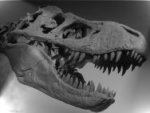 While
they occupy a tiny part of the monophyletic Class Reptilia,
the extinct non-avian dinosaurs capture the imagination of
many people of all ages. A relatively recent scientific revelation
is that dinosaurs are in fact not extinct, since birds are
now considered to be descendants of non-avian dinosaurs.
Dinosaurs appeared and thrived during the Mesozoic Age
between 231 and 65 million years ago. All dinosaurs were
terrestrial, though their close relatives
were aquatic or marine. They are differentiated
While
they occupy a tiny part of the monophyletic Class Reptilia,
the extinct non-avian dinosaurs capture the imagination of
many people of all ages. A relatively recent scientific revelation
is that dinosaurs are in fact not extinct, since birds are
now considered to be descendants of non-avian dinosaurs.
Dinosaurs appeared and thrived during the Mesozoic Age
between 231 and 65 million years ago. All dinosaurs were
terrestrial, though their close relatives
were aquatic or marine. They are differentiated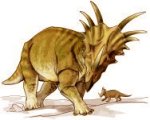 from
other reptiles by skulls
with two extra openings behind the orbits, a perforate acetabulum
(hip socket) that more directly supported the weight of the
articulation with the legs than in the usual reptilian morphology,
and three or more vertebrae comprising the sacrum. Dinosaurs
evolved to amazing diversity, occupying an amazing array
of ecological niches. Some dinosaurs were huge and some were
bird-size. Some walked on four legs and some on two legs.
Some were fierce meat-eaters and some were docile plant eaters.
Dinosaur fossils have been found on every continent on earth
and dominated
earth during the
from
other reptiles by skulls
with two extra openings behind the orbits, a perforate acetabulum
(hip socket) that more directly supported the weight of the
articulation with the legs than in the usual reptilian morphology,
and three or more vertebrae comprising the sacrum. Dinosaurs
evolved to amazing diversity, occupying an amazing array
of ecological niches. Some dinosaurs were huge and some were
bird-size. Some walked on four legs and some on two legs.
Some were fierce meat-eaters and some were docile plant eaters.
Dinosaur fossils have been found on every continent on earth
and dominated
earth during the 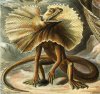 Jurassic, with many new groups appearing.
The Cretaceous period saw the peak of dinosaur
evolution when huge carnivores like Tyrannosaurus rex and
Giganotosaurus appeared,
as did Triceratops and numerous others.
Jurassic, with many new groups appearing.
The Cretaceous period saw the peak of dinosaur
evolution when huge carnivores like Tyrannosaurus rex and
Giganotosaurus appeared,
as did Triceratops and numerous others.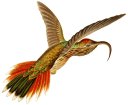 members of the
theropod dinosaurs with whom they likely share the closest
commen ancestor.
members of the
theropod dinosaurs with whom they likely share the closest
commen ancestor.

| Fossil
Mall Home |