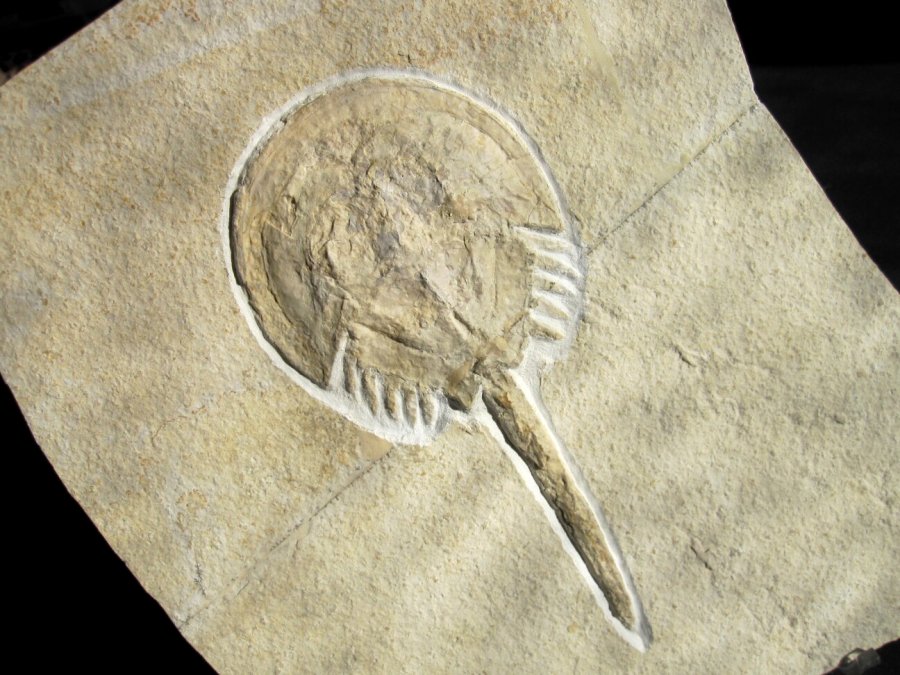
Mesolimulus walchi
Phylum Arthropoda, Subphylum Chelicerata, Class Xiphosura
Geological Time: Upper Jurassic
Size (25.4 mm = 1 inch): Fossil is 12.7 cm in length ( 5”) on a large 22.8 x 20.3 cm (9 ½ x 8”) plate
Fossil Site: Solnhofen Limestone, "plattenkalk” Malm Zeta 2, Eichstatt, Germany
Fossil Code: PFS010
Price: $750.00 - sold
Xiphosura, the horseshoe crabs, are related to the extinct Eurypterids, and more distantly to spiders and scorpions. Their lineage traces back to the Cambrian, and extends to modern times as the genus Limulus. This fossil is of a similar genus known as Mesolimulus from the Solnhofen lithographic limestone deposits of Eichstatt, Germany. The 150 million year old lagerstätte deposits of Solnhofen are famous for their exceptionally well-preserved organisms, the most famous of which are the handful of specimens of the ancient bird Archaeopteryx. While there are only three extant genera and five extant species of Class Xiphosura, they were quite diverse during the Palaeozoic Era. Because they have apparently undergone little change, the extant horseshoe crabs are often considered to be living fossils. Horse shoe crabs have a large shield that covers the cephalothorax, and the carapace is hinged between the cephalothorax and abdomen. The sturdy exoskeleton comprises three parts, the large semicircular cephalothorax, the opisthosoma which is the posterior portion of body behind the cephalothorax, and a long tail spine or telson. The resemblance to trilobites is apparent, and, in fact, the Xiphosura are considered by many to be the closest living relatives of the long-extinct trilobites. |