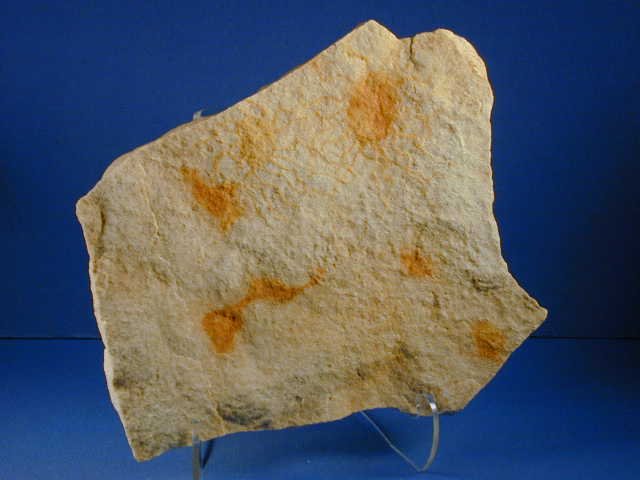
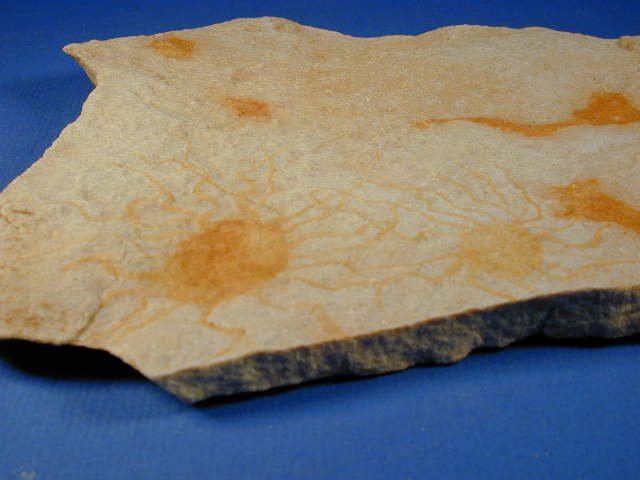
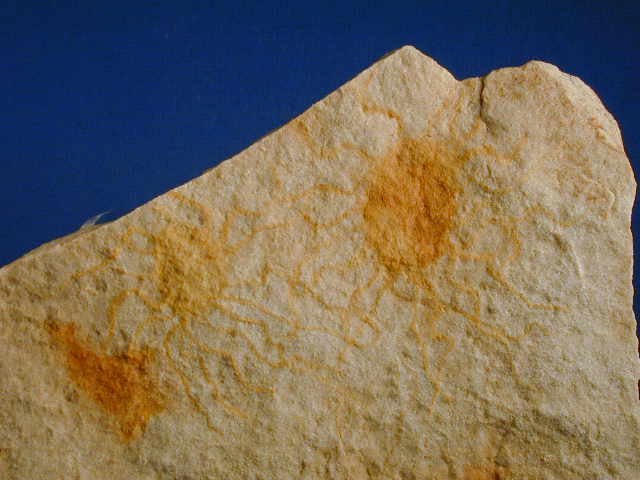
Cambrian Jellyfish Scyphozoa Fossils Pair
"2 tentacle Jellyfish"

Name: Phylum: Cnidaria; Class: Scyphozoa; undescribed jellyfish

Age: Middle Cambrian

Size (25.4mm=1 inch): Matrix: 7.5 by 6.9 inches

Location: Krukowski Quarry, Mount Simon Sandstone Outlier, Mosinee,Wisconsin

Code: DD426

Price: $175.00 + actual shipping


Here we have two Cambrian Scyphozoa jellyfish from the famous Krukowski quarry in Central Wisconsin that is currently under intense scientific study. The Krukowski quarry yields ichnofossils that are the earliest evidence of terrestrialization of animals in the fossil record. The animals have yet to be described in the literature, though publication can be soon anticipated.

The plate contains two tentacle jellyfish, which are rare in the quarry. This particular specimen is from a new layer with the first such tentacle jellyfish to be recovered in three years. The specimen marked #1 is particularly nice, and its relatively high relief may be due to the jellyfish pumping sand rather than water in an attempt to escape from the beach back to the water.

It comes from a particular horizon in the Mount Simon Sandstone formation that also yields fascinating Diplichnites, huge Jellyfish (Medusae) and Climactichnites. Jellyfish body fossils are incredibly subtle, and therefore this specimen has been subtly stained.

Being comprised entirely of soft tissue (living jellyfish are about 95 % water), unlike animals with exoskeletons (e.g., trilobites) or skeletons (vertebrates), jellyfish fossils are body fossils that are impressions of the jellyfish. Such fossil impressions are rare throughout the fossil record. Jellyfish were some of the most ferocious predators of the Cambrian marine environment. These fossils are almost surely the result of a mass stranding on an ancient Cambrian beach, possibly caused by a storm surge. Science believes jellyfish fossils may only result from being stsanded on a beach, and subsequent lack of predation and rapid burial by sediment or other material. At least during the Cambrian there were no purely land-based predators.

Phylum Cnidaria (anemones, corals, jellyfish and sea pens) are among the most ancient animals and has one of the longest fossil histories of metazoans. Though simple in body form, they remain ubiquitous and widespread in modern marine environments. The earliest forms in the fossil record appear in Ediacarian fauna of Southern Australia, which dates to the Precambrian some 600 million years ago. Their persistence is clear testament that old and simple animals can be enormously successful, and that the clique' "climbing the evolutionary ladder" is a misnomer; rather, life either adapts to the current and changing environment, or perishes.


Stonerelic Fossils Purchase Information

Click pix to enlarge

Fossil Mall Navigation:

l Home l Fossils for Sale Map l Museum and Rare Fossils l How to Buy Fossils l

Navigate by Fossil Store:
l EDCOPE Enterprises l Western Fossils l Stonerelic l
l Pangaea Fossils l Primal Extincts l

Navigate by Fossil Category:
l Fossil Amber l Ammonites l Dinosaur and Reptile Fossils l
l Crinoids and Echinoderms l Fish Fossils l Insect Fossils l Invertebrate Fossils l
l Plant Fossils l Stromatolites l Trace & Ichnofossils l Trilobites l
l Russian Trilobites l Vertebrate Fossils l Fossil Kits l

Fossils & Science:
l Science Section l Paleobiology and Geological Timeline l The Fossil Dealers l