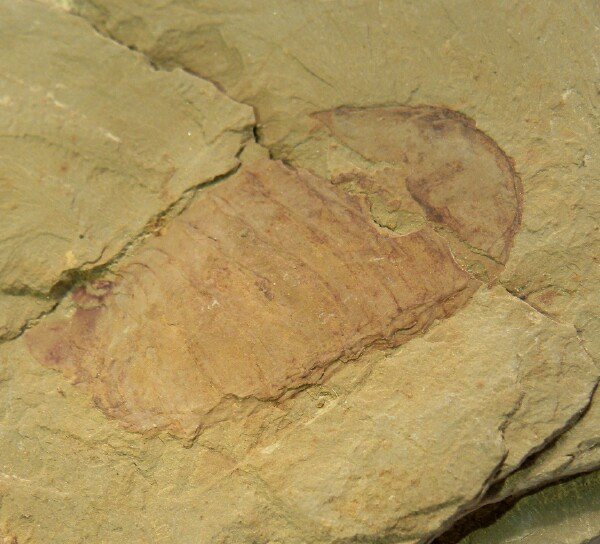
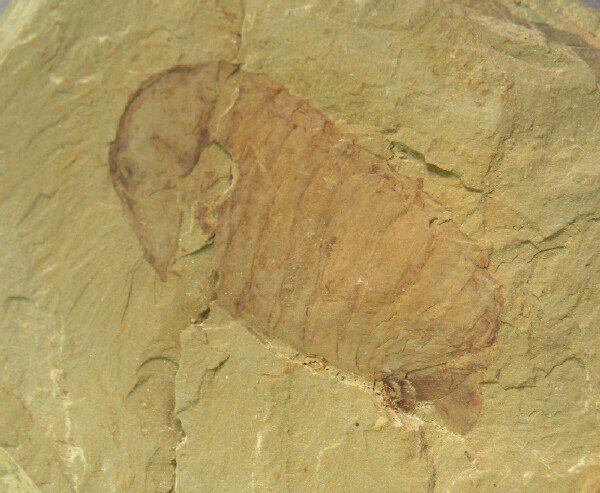
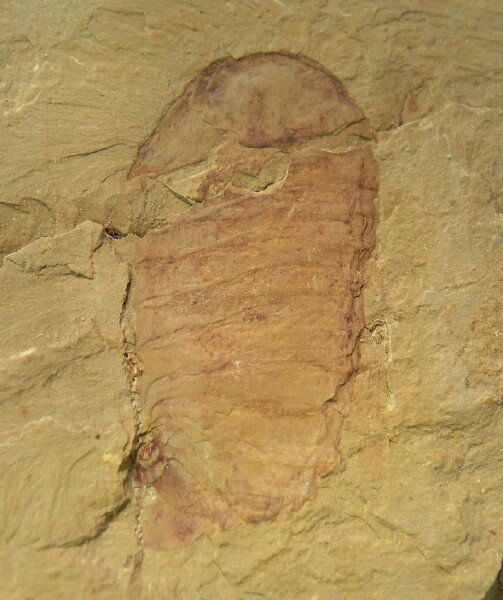
Cf Mollisonia
sinica
Phylum Arthropoda
Geological
Time: Early Cambrian (~525 million years ago)
Size (25.4
mm = 1 inch): Fossil is 21 mm long by 11 mm wide on a 40 mm by 38 mm
matrix
Fossil
Site: Chengjiang Maotianshan Shales - Quiongzhusi Section, Yu’anshan
Member, Heilinpu Formation, Mafang Village, Haikou County, Kunming, Yunnan
Province, China
Fossil Code:
CJF887
Price: $425.00
- sold
|  Description:
This unusual arthropod is known as Mollisonia sinica. The genus
was described from the younger Burgess Shale. With the discovery
of the Chengjiang Biota in 1984 a window on the Cambrian Explosion
in China was opened. The diversity of soft-tissue fossils is
astonishing: algae, medusiforms, sponges, priapulids, annelid
like worms, echinoderms, arthropods (including trilobites), hemichordates,
chordates, and the first agnathan fish make up just a small fraction
of the total. Numerous problematic forms are known as well, some
of which may have represented failed attempts at diversity that
did not persist to the present day. The taxon has been found
in the younger Kaili Biota of China. The species has just recently
been discovered in the Chengjiang Biota itself, making this possibly
the third member of the genus, and the oldest of all. Description:
This unusual arthropod is known as Mollisonia sinica. The genus
was described from the younger Burgess Shale. With the discovery
of the Chengjiang Biota in 1984 a window on the Cambrian Explosion
in China was opened. The diversity of soft-tissue fossils is
astonishing: algae, medusiforms, sponges, priapulids, annelid
like worms, echinoderms, arthropods (including trilobites), hemichordates,
chordates, and the first agnathan fish make up just a small fraction
of the total. Numerous problematic forms are known as well, some
of which may have represented failed attempts at diversity that
did not persist to the present day. The taxon has been found
in the younger Kaili Biota of China. The species has just recently
been discovered in the Chengjiang Biota itself, making this possibly
the third member of the genus, and the oldest of all.
Also
see: Chengjiang
Biota Fauna List Chengjiang
Fossils
|
|