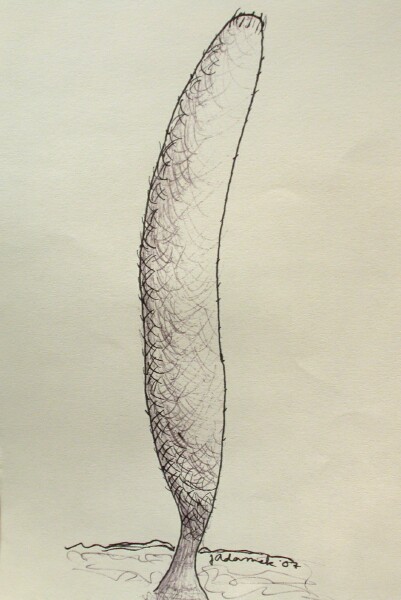
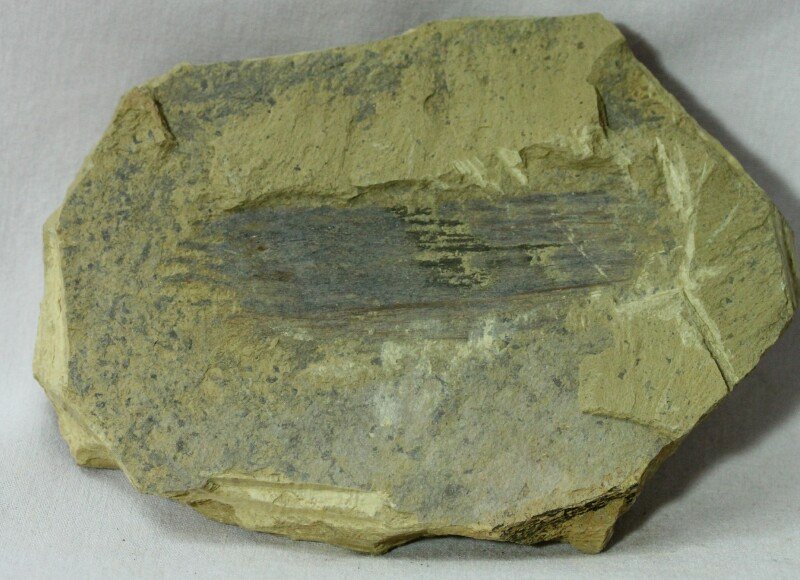
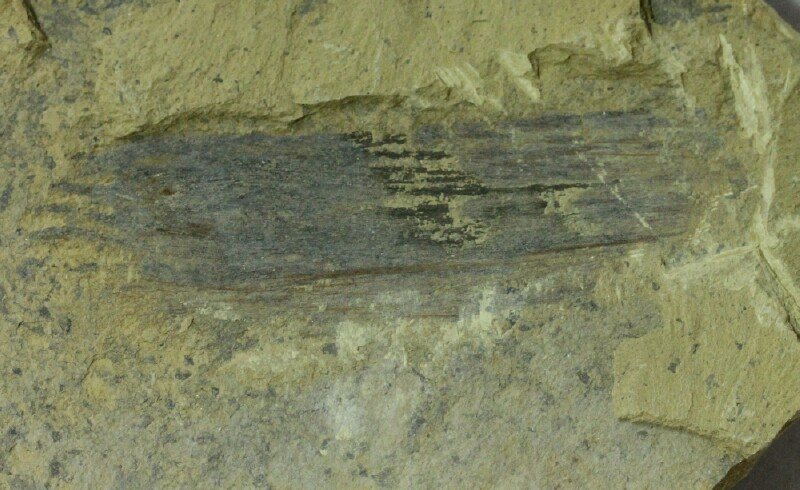
Naraoia spinosa from Chengjiang with Digestive System Preservation
Often described as a soft bodied trilobite

Naraoia spinosa (Chengjiang)

Naraoiidae

Geological Time: Early Cambrian (~525 million years ago)

Size (25.4mm=1 inch): 23 mm long by 14 mm wide on a 25 mm by 45 mm matrix.

Fossil Site: Chengjiang Maotianshan Shales - Quiongzhusi Section, Yu’anshan Member, Heilinpu Formation, Mafang Village, Haikou County, Yunnan Province, China

Code: CJF544

Price: $365.00 - sold


Naraoia spinosaDescription: The exact taxonomic status of this arthropod is in dispute. It has been termed a “trilobitomorph” by some researchers, showing their beliefs in its close affinity with the trilobites. While the Trilobitoorpha was listed in the Treatise, most now consider that this subphylum is invalid, a catchall much like some of the dustbin terms used by Walcott for a number of the Burgess Shale fauna. Whittington termed it a “soft-bodied trilobite”’ but that belief is not supported at present. Their similarity in appearance to the Agnoistida is purely a result of convergence. Two large groupings of the Paleozoic arthropods are currently in favor: the Crustaceomorpha (which includes Waptia) and the Arachnomorpha, Naraoia dominated by the trilobites.

The Naraoiidae are arachnomorphs and include Misszhouia and Naraoia, with this one, Naraoia spinosa, named for the spinose cuticle so well preserved here. The species is one found in several locations within Yunnan Province. The diversity of soft-tissue fossils is astonishing: algae, medusiforms, sponges, priapulids, annelid-like worms, echinoderms, arthropods (including trilobites), hemichordates, chordates, and the first agnathan fish make up just a small fraction of the total. Numerous problematic forms are known as well, some of which may have represented failed attempts at diversity that did not persist to the present day.

This one shows many of the classic features of the taxon, even the diverticulae (digestive glands) and the central gut are evidence, as is much of the soft cuticle that betrays the outline of the body. Even if it is not a true trilobite, it is sure to be a coveted addition to any collection. What makes this one even more unusual is the fact that some of the internal organs have been preserved in three dimensions, rather than the typical flat specimens most often seen.

EDCOPE Enterprises Fossils Purchase

click to enlarge


Fossil Mall Navigation:

l Home l Fossils for Sale Map l Museum and Rare Fossils l How to Buy Fossils l

Navigate by Fossil Store:
l EDCOPE Enterprises l Western Fossils l Stonerelic l
l Pangaea Fossils l Primal Extincts l

Navigate by Fossil Category:
l Fossil Amber l Ammonites l Dinosaur and Reptile Fossils l
l Crinoids and Echinoderms l Fish Fossils l Insect Fossils l Invertebrate Fossils l
l Plant Fossils l Stromatolites l Trace & Ichnofossils l Trilobites l
l Russian Trilobites l Vertebrate Fossils l Fossil Kits l

Fossils & Science:
l Science Section l Paleobiology and Geological Timeline l The Fossil Dealers l