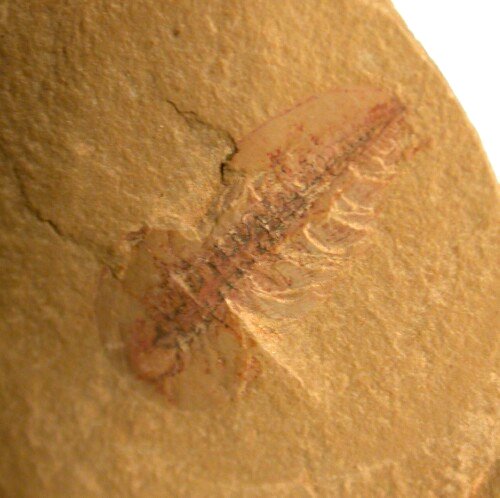
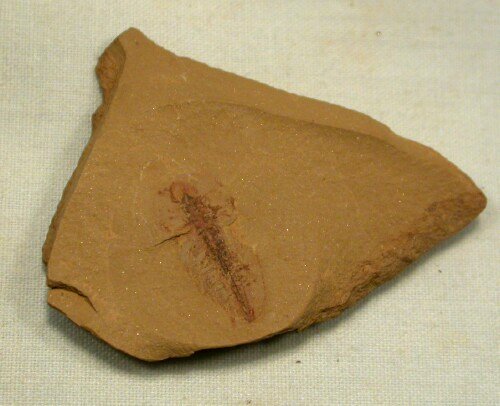
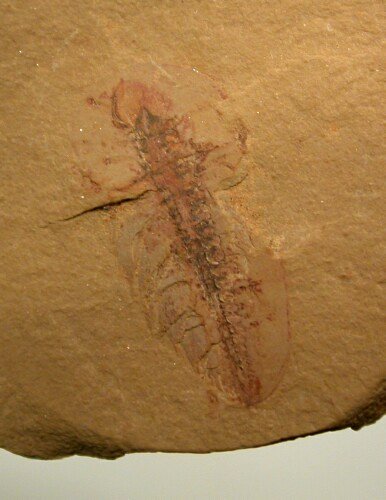
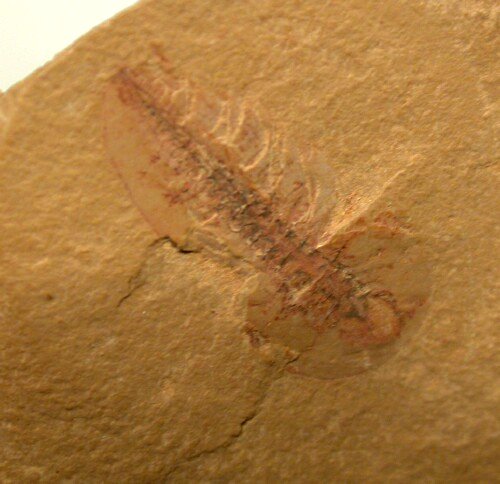
Name: Naraoiidae: Misszhouia (Naraoia) longicaudata
Age: Early
Cambrian Qiongzhusi Section, Yu'anshan Member, Heilinpu Formation
(~525 million years ago)
Size (25.4mm=1 inch): 14 mm long by 7 mm wide on a 28 mm by 35 mm matrix
Location: Maotianshan Hill, Yuxi, Chengjiang County, Yunnan Province, China
Code: CJF011
Price: $625.00 - Sold
|
Misszhouia longicaudata was initially placed within Naraoia, but was given its own genus based upon differences between it an Naraoia copacta of the Burgess Shale. The species is one found in several locations within Yunnan Province, but this one is from the most famous location of all, Maotianshan, site of the discovery of the Chegjiang Biota by Hou Xian-guang in 1984. Indeed, it is this taxon which was first discovered at Maotianshan to start the entire cycle of research. The diversity of soft-tissue fossils at Jengjiang is astonishing: algae, medusiforms, sponges, priapulids, annelid-like worms, echinoderms, arthropods (including trilobites), hemichordates, chordates, and the first agnathan fish make up just a small fraction of the total. Numerous problematic forms are known as well, some of which may have represented failed attempts at diversity that did not persist to the present day. This specimen shows many of the classic features of the taxon, even the diverticula and the central gut are evidence, as is the soft cuticle that betrays the outline of the body. Even if it is not a true trilobite, it is sure to be a coveted addition to any collection, one of historical significance due to its ties with the discovery of the Chengjiang Biota. |