Cowralepis
mclachlani
Placodermi,
Phyllolepida
Geological
Time: Middle Devonian
Size: Head
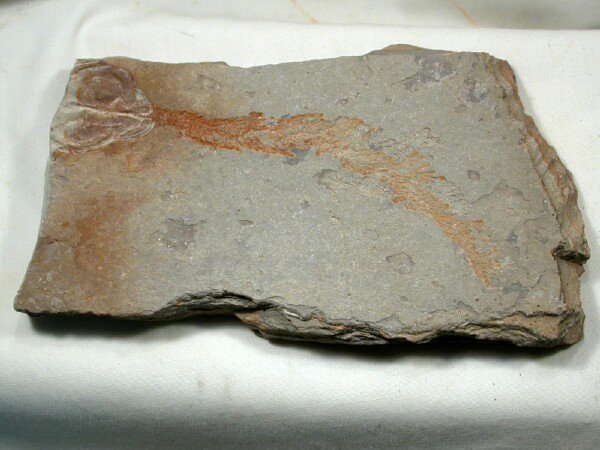
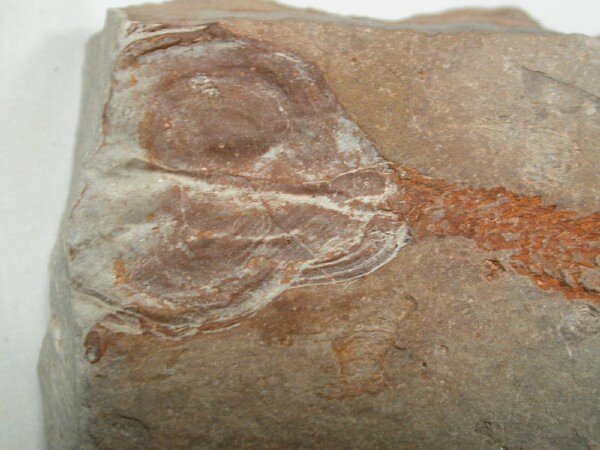
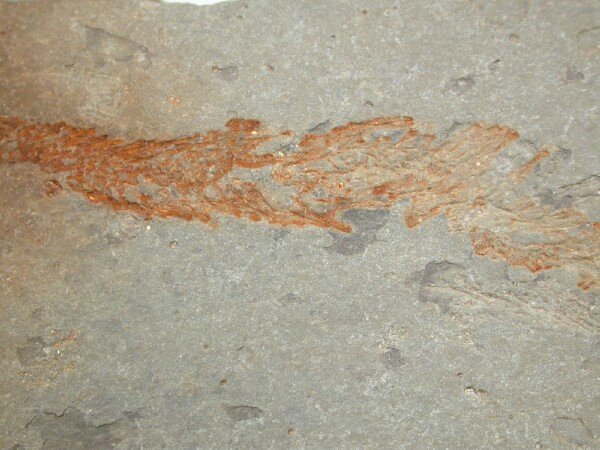
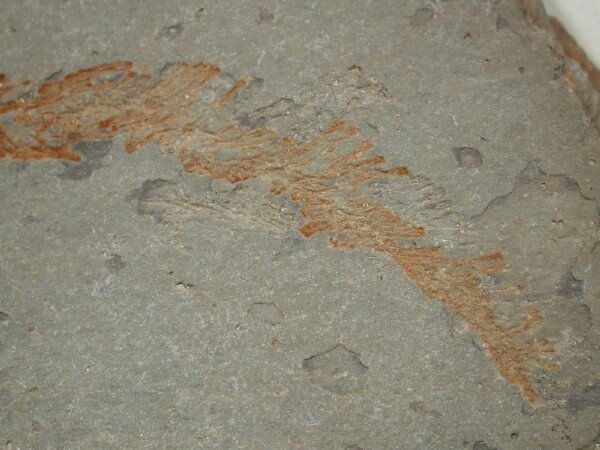
and trunk shield: 30 mm in length (as preserved) and 30mm wide tail:
110 mm along backbone on a 50 mm by 155 mm matrix
Fossil Site:
Merriganowry Shale Member, Cowra, New South Wales, Australia
|  Description:
A new taxon of phyllolepid placoderms was described in 2005 as a
result of a study of numerous articulated specimens which were first
discovered in the early 1990s in the crushed shoulder material for
approach roads to the Merriaganowry bridge. The material was traced
to a nearby quarry, uncovering a vast treasure of specimens of various
sizes. Before this time, only 2 sites for articulated phyllolepids
were known in Scotland and Mt Howitt, Victoria, Australia. Phyllolepids
derive their name (meaning “leaf scale”) from the distinctive
ridged ornamentation of the bony dermal plates. This species was
named for the landowner of the quarry. The fish-bearing sequence
is some 25 meters in thickness, and hundreds of bedding planes containing
specimens are known, the most complete source of articulated specimens
known in the world. Interestingly, this is the sole fish found in
the deposit, with a few pieces of eurypterid integument and lycopod
plant remains and other plant debris the only other fossils found
to date. The head and trunk shield are missing only the leading
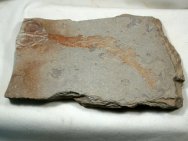
edge, and essentially all of the tail is preserved as well. Description:
A new taxon of phyllolepid placoderms was described in 2005 as a
result of a study of numerous articulated specimens which were first
discovered in the early 1990s in the crushed shoulder material for
approach roads to the Merriaganowry bridge. The material was traced
to a nearby quarry, uncovering a vast treasure of specimens of various
sizes. Before this time, only 2 sites for articulated phyllolepids
were known in Scotland and Mt Howitt, Victoria, Australia. Phyllolepids
derive their name (meaning “leaf scale”) from the distinctive
ridged ornamentation of the bony dermal plates. This species was
named for the landowner of the quarry. The fish-bearing sequence
is some 25 meters in thickness, and hundreds of bedding planes containing
specimens are known, the most complete source of articulated specimens
known in the world. Interestingly, this is the sole fish found in
the deposit, with a few pieces of eurypterid integument and lycopod
plant remains and other plant debris the only other fossils found
to date. The head and trunk shield are missing only the leading
edge, and essentially all of the tail is preserved as well.
|
|