 The
Paleozoic is often called the age of the trilobite. Trilobites
particularly flourished
in the oceans of the Cambrian and Ordovician periods, beginning
around 540 million years ago, with a diminishing
number of families persisting until the Permian. The
number of families actually peaked
in the Late Cambrian when an
extinction
event removed many. The morphological diversity actually
peaked in the Ordovician. Many more families were removed
at the end
of the Ordovician 440 million years ago during a great
ice age where ice sheets advanced to the equator. The diminished
number
of trilobite families that survived to the Silurian radiated
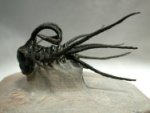
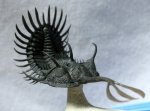
into new and exotic forms, and still more exotic spiny
and
pustulose
forms in the Devonian. The Devonian was punctuated by periods
of rising seas that disrupted the reef systems where the
trilobites
flourished, forcing selective adaptation. The end of the
Devonian saw the Frasnian-Famennian event where only Proteus
survived
into the Carboniferous. Despite reduced ancestry, with
decent with modification ruling, these trilobites filled
the same
ecological
niches such that adaptation led to a repeating of many
of the forms of their extinct cousins. While the genetic
path
was assuredly
different, the newly evolved forms had recognizable morphological
similitude with those long extinct. Regrettably, trilobites
never truly recovered in the Carboniferous, with but a
handful of genera from Order Proetida extant by the Permian.
Failing to adapt to deep-water
habitats, trilobite vulnerability to climatic change remained
and
led to their disappearance prior to yet another great mass
extinction at the end of the Permian. The age of the trilobite
yielded
to the age of the insect.
The
Paleozoic is often called the age of the trilobite. Trilobites
particularly flourished
in the oceans of the Cambrian and Ordovician periods, beginning
around 540 million years ago, with a diminishing
number of families persisting until the Permian. The
number of families actually peaked
in the Late Cambrian when an
extinction
event removed many. The morphological diversity actually
peaked in the Ordovician. Many more families were removed
at the end
of the Ordovician 440 million years ago during a great
ice age where ice sheets advanced to the equator. The diminished
number
of trilobite families that survived to the Silurian radiated
into new and exotic forms, and still more exotic spiny
and
pustulose
forms in the Devonian. The Devonian was punctuated by periods
of rising seas that disrupted the reef systems where the
trilobites
flourished, forcing selective adaptation. The end of the
Devonian saw the Frasnian-Famennian event where only Proteus
survived
into the Carboniferous. Despite reduced ancestry, with
decent with modification ruling, these trilobites filled
the same
ecological
niches such that adaptation led to a repeating of many
of the forms of their extinct cousins. While the genetic
path
was assuredly
different, the newly evolved forms had recognizable morphological
similitude with those long extinct. Regrettably, trilobites
never truly recovered in the Carboniferous, with but a
handful of genera from Order Proetida extant by the Permian.
Failing to adapt to deep-water
habitats, trilobite vulnerability to climatic change remained
and
led to their disappearance prior to yet another great mass
extinction at the end of the Permian. The age of the trilobite
yielded
to the age of the insect.
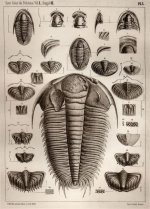 Trilobites
comprise a complex and huge clade of arthropods with estimates
of number of species exceeding 15,000. The extinct
trilobite represents a problem for classification, a problem
unlikely to benefit from modern genomic science. Darwin was
confident in his conjecture that trilobites descended from
one
Pre-Cambrian
crustacean ancestor. But, the trilobite's position in the universal
tree of life remains a mystery today, with debate remaining
whether their closest extant cousins are, for example, the
horseshoe crabs, the spiders or the scorpions. Classification
requires
following the tree of life back to points of branching. This
we cannot do for the trilobite whose first appearance in the
fossil record is in the Cambrian. When they appear, they are
already diverse in form, and dispersed in geography, clearly
indicative of the incomplete nature of the fossil record. The
highly diverse soft-bodied and jointed-legged animals that
were
ostensibly produced in the Cambrian explosion, but must also
have Precambrian ancesters intensify the mystery. Among the
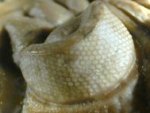
Cambrian fauna, the crystal eyes of trilobites are unique.
In the eyes is a strong clue, since the fossil record indicates
pre-sight neural tissue existed in forms of worms that
contain segmented morphology also retained in the trilobite
forms. Mystery is allure for those with a scientific propensity,
and the trilobite does not disappoint. Reading Richard
Fortey's recent book "Trilobite! Eyewitness to
Evolution",
you can almost feel the author's sadness that these magnificent
animals that once dominated life on Earth, declined near the
end of the Paleozoic with but a single order surviving to the
Carboniferous, before it too faded away.
Trilobites
comprise a complex and huge clade of arthropods with estimates
of number of species exceeding 15,000. The extinct
trilobite represents a problem for classification, a problem
unlikely to benefit from modern genomic science. Darwin was
confident in his conjecture that trilobites descended from
one
Pre-Cambrian
crustacean ancestor. But, the trilobite's position in the universal
tree of life remains a mystery today, with debate remaining
whether their closest extant cousins are, for example, the
horseshoe crabs, the spiders or the scorpions. Classification
requires
following the tree of life back to points of branching. This
we cannot do for the trilobite whose first appearance in the
fossil record is in the Cambrian. When they appear, they are
already diverse in form, and dispersed in geography, clearly
indicative of the incomplete nature of the fossil record. The
highly diverse soft-bodied and jointed-legged animals that
were
ostensibly produced in the Cambrian explosion, but must also
have Precambrian ancesters intensify the mystery. Among the
Cambrian fauna, the crystal eyes of trilobites are unique.
In the eyes is a strong clue, since the fossil record indicates
pre-sight neural tissue existed in forms of worms that
contain segmented morphology also retained in the trilobite
forms. Mystery is allure for those with a scientific propensity,
and the trilobite does not disappoint. Reading Richard
Fortey's recent book "Trilobite! Eyewitness to
Evolution",
you can almost feel the author's sadness that these magnificent
animals that once dominated life on Earth, declined near the
end of the Paleozoic with but a single order surviving to the
Carboniferous, before it too faded away.
|
|
|
|
|
|
|
|
|
|
|
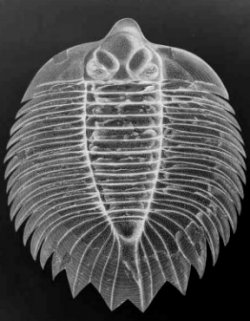
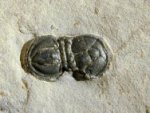
Agnostid
trilobites:
- Lower
Cambrian to Upper Ordovician
- Among
the most primitive of trilobites
- Length
of a few mm and smaller
- Similar
cephalon and pygidium (isopygous)
|
-
-
Among
the most primitive of trilobites from early Cambrian
-
Many
thoracic segments and small pygidium
-
Spinocity
usually limited to pleurae tip
|
|
|
|
|
|
|
|
|
|
-
Middle
Cambrian to Upper Devonian
- Allied
by having hypostomal attachment in common
-
|
-
-
Often
elaborate and often highy spinou
|
|
|
|
|
|
|
|
|
- Particularly
noted for detailed preservation of compound eyes
-
Typical
deep furrows between thoracic segments
-
|
-
-
The
last survivors before Trilobita faded away, and
disappeared in the Permian extinction
-
Typically
small with small spineless pygidium
|
|
|
|
|
|
|
|
|
|
- Middle
Cambrian to Lower Silurian
- Ubiquitous
trilobites sharing distinct suture structure
-
Effacement
of features common with typically large pygidium
|
-
Upper
Cambrian to Upper Devonian
-
Presence
of the broad semicircular to ovate brim
-
|
|
|
|
|
|
|
|
|
|
- Lower
Cambrian to Devonian
- Appeared
early and persisted long, yielding much variability
in form
-
Formerly
included what is now Suborder Harpina
-
|
-
Precambrian
to Upper Cambrian
- Soft
bodies
-
Fossil
record generally limited to Lagerstatten
|
Also
see: Trilobite References