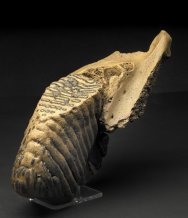
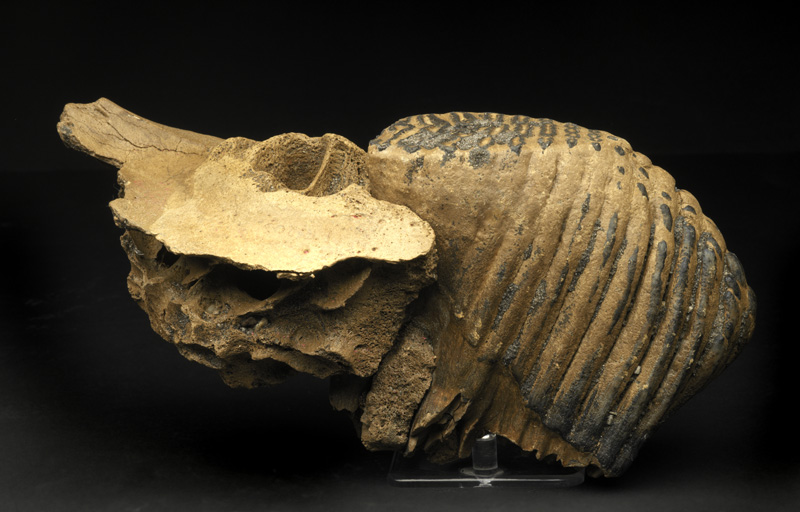
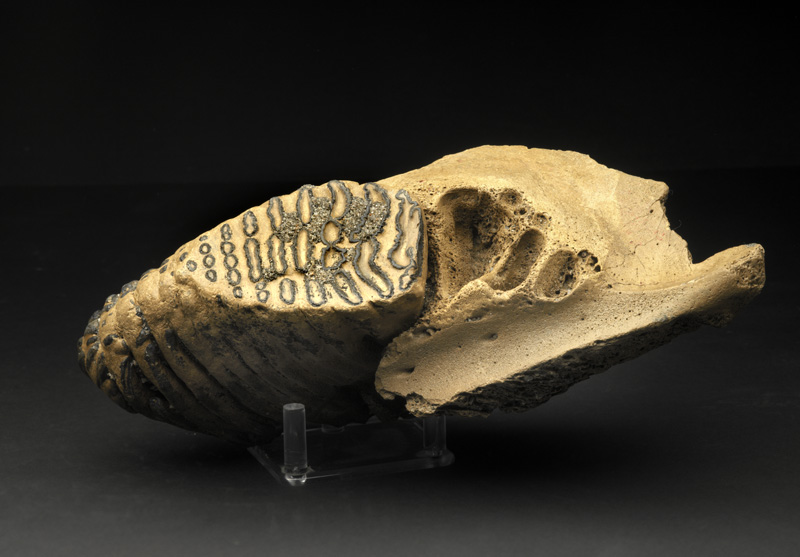
Superior Siberian Wooly Mammoth Molar Fossil

Mammuthus primigenius

M3 type Molar of a Woolly Mammoth

Geological Time: Pleistocene (30-50 thousand years ago)

Size and Weight: 21 cm in length by 19 cm high by 8.5 cm in width (8 ¼ X 7 ½ x 3 3/8”) - almost 7 lbs (2.960 kg).

Fossil Site: Siberia, Russia

Fossil Code: PFV153

Price: $750.00 - sold


Mammuthus primigenius Fossil ToothDescription: This beautiful and striking Mammuthus primigenius molar comes directly from the vast, harsh wastelands of Siberia. The preservation is remarkable and natural mineral replacement processes in fossilization that resulted in a spectrum of light brown hues. At almost 7 lbs (2.960 kg), its as heavy and dense as the rock it became since tens of thousands of years ago when humans were still roving bands of hunter gatherers. The woolly mammoths met extinction at the end of the Pleistocene (12,000 years ago), probably as a result of climate change together with the effects of human hunting.

The molars of the woolly mammoth, like those of other mammoths and elephants were large, specialized structures with a flattened grinding surface. Low ridges of dense enamel run across the surface of the teeth, making them ideal for grinding grasses. As with mastodons, a mammoth will have a series of six cheek teeth (premolars and molars) on each side of the jaw (a total of 24 teeth for both upper and lower jaws.) Younger mammoths had three teeth on each side, while most adults had two, and the old animals had one. As the teeth were worn down, they were replaced by teeth growing in from the back. Newer teeth were larger and contained more ridges than older teeth.

I also need to dispel self-serving disinformation I’ve seen on the Internet regarding Mammoth teeth from Siberian sedimentary deposits, compared with those brought up from the sea. The former are clearly more aesthetic, and the natural preservation and structural integrity has not been compromised by the adverse chemical effects and dissolution during sea water submersion as in the latter. The former smells like the rock that it is and the latter smells like the hydrocarbons required to restore structure integrity with many shellac-like coating. At the 2008 Tucson Fossil show, the former were scarce and relatively expensive, and latter were prevalent and pretty inexpensive. Pitching fossils as investments reminds me of the coin and pawn shop near where I grew up. If I thought fossils were good investment vehicles, I would recommend Mammoth teeth from Siberia, so don’t be duped by the disinformation. The Mammoth teeth from the North Sea are just fine, especially since they should be a bargain compared to those from Siberia, if you don’t mind the smell. The Siberian teeth are also safer around small children.

We’ve also seen a suggestion that preservation with burial in frozen Siberia somehow equates to that on the sea floor. A non-scientist can deny this silly hypothesis by asking whether the Titanic would look better if buried in Siberia. The markedly different chemical conditions lead to concomitantly differential chemical processes and mineral exchange during fossilization, the complex processes where organic material becomes, yes, stone. We do agree that melted ice becomes water, however, contracting in volume during that phase change below 0.0 degrees centigrade. As for the toxicity problem noted above, adequate protection can probably be acquired by an extra heavy coat of glossy black enamel, though this may collaterally comprise surface details and hide the natural hues through absorption of all frequencies of the visible electromagnetic spectrum. Then again: “how many ways can you arrange the deck chairs on the Titanic? – answer: who cares?

Fossil Sales Information

click fossil pictures to enlarge


Fossil Mall Navigation:
l Home l Fossils for Sale Map l Museum and Rare Fossils l Fossil Sales l

Navigate by Fossil Store:
l EDCOPE Enterprises l Western Fossils l Stonerelic l
l Pangaea Fossils l Primal Extincts l

Navigate by Fossil Category:
l Fossil Amber l Ammonite Fossils l Dinosaur and Reptile Fossils l
l Crinoids and Echinoderms l Fossil Fish l Insect Fossils l Invertebrate Fossils l
l Plant Fossils l Stromatolites l Trace & Ichnofossils l Trilobite Fossils l
l Russian Trilobites l Vertebrate Fossils l Fossil Kits l

Fossils & Science:
l Science Section l Paleobiology and Geological Timeline l The Fossil Dealers l